
A few days back, Jeremy Smith attended the Procurement Leaders | A World 50 Group Community World Procurement Conference, an event that brought together over 800 procurement leaders. It was the 20th anniversary of Procurement Leaders running this event too, so much to reflect on. This conference provided a great opportunity to delve into pressing retail and consumer challenges that a lot of our current clients are facing such as ESG, resilience, performance, partnerships, and digitalization.
Global CPOs shared insights on essential partnerships, people, purpose, and skills required in modern sourcing, emphasizing the need for agile and interconnected procurement teams to drive financial impact. Key discussions revolved around balancing sustainability with profitability, leveraging innovation for net zero goals, and fostering transparent, compliant, and socially responsible supply chains. It was great to understand from different industry points of view how procurement strategies must adapt to evolving demands while addressing global business, environmental, and societal needs.
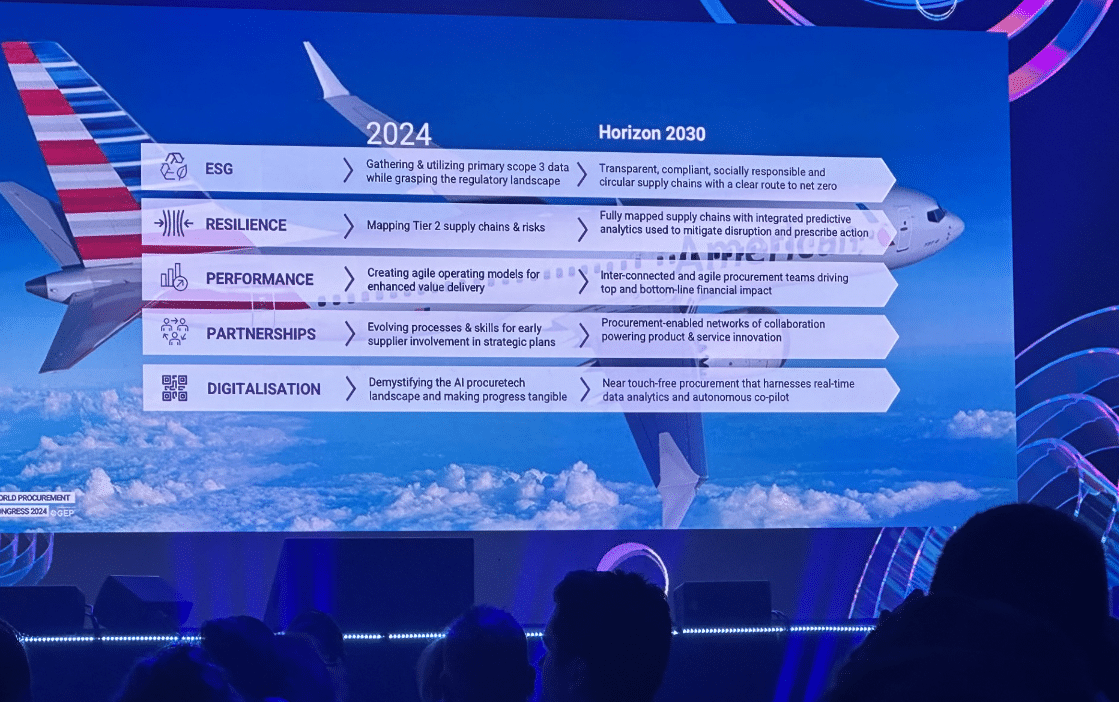
The theme of the event was ‘glide paths for sustainable growth’ and approaches to Horizon 2030
Our Takeaways
ESG: A Collaborative Effort
Rob Alexander (SVP, Global Supply Chain & UK Country Manager, Kongsberg Maritime ) and Chris Garwood (VP Supply Chain Solutions, bp) stressed collaboration in achieving sustainability targets. While legislation can set the stage, real progress in sustainability requires the entire supply chain to work together. Chris shared insights from BP’s efforts to use Sustainable Aviation Fuel (SAF), noting collaborative approaches are essential for transformational change in emissions. SAF is expected to grow significantly from its current ~2% to 22% of supply by 2040.
Janelle Orozco (CPSO NA Zone, The Kraft Heinz Company) and Hervé Le Faou (CPO, The HEINEKEN Company) also highlighted working with peers and competitors to influence the supply chain for the greater good, advocating for collective efforts in bearing costs and achieving sustainability goals.
From our experience, improving cross-functional collaboration has been critical to align on net zero strategy and make impactful change. If you go this on your own you will make some benefits, which is better than doing nothing, but if you work collaboratively we can really make the difference we need to!
Resilience Through Strategic Management
Costas Xyloyiannis, (CEO, HICX) emphasized future success hinging on effective supply chain management, stressing information sharing, robust Supplier Relationship Management, proactive supply chain design, and accelerating geographic diversity.
Of course this list is not exhaustive, we believe supply chain resilience comes through understanding the whole value chain in detail and working through specific business pain points. If COVID taught us one thing, and it taught us many, then it showed us how our supply chains are more interdependent that we thought, so understanding beyond Tier 2 is more important than many people think right now. We get that it is resource / data intensive, but that is where they fell over before, and that lack of understanding will bite again…
Performance: Enhancing Efficiency and Impact
There is no one size fits all procurement organisational model, as long as it is servicing the organisation effectively. Richard Crane from (CPO, Haleon ) discussed balancing global leverage with local relevance, advocating for efficient procurement functions through clustering. Paul Gardner from MarsPet Nutrition described a different model where a small central team supports larger regional teams, focusing on categories, price risk, and circularity.
We have seen a variety of organisational structures, some of which work better than others! What we have observed over the last few years is that it’s an exciting time to be a procurement professional, with greater exposure to the business and tools allowing a focus on impactful teams to drive commercial efficiencies. The Hybrid examples they gave are also the current trend in Consumer Goods companies like theirs, however we know they go in cycles, so let’s see how long Hybrid exists and whether the next evolution is a tweak to Hybrid (our expectation) or will be revisiting centralised vs. Decentralised again?
Partnerships through (more) Collaboration
Everyone seems to be aligned on collaboration, but the biggest question is how does this work in practice when many procurement teams are very siloed? Hugo Sparidans (CPO, Versuni) emphasized supplier collaboration in adding significant value to the top line, with untapped potential in collaborating with new suppliers. Adam Weisswasser (CPPO, Hewlett Packard Enterprise) also highlighted driving successful outcomes through collaboration and adapting supply chains to meet changing customer needs.
Digitalization Through Solid Foundations
Patricia Stroup (CPO, Nestlé) warned that without solid foundations, digitization efforts may lead to doing the wrong things faster, emphasizing effective change management and implementation. Thomas Gaengler (CPO, Mondelēz International) focused on addressing fragmented data challenges and the need for better data before leveraging AI for insights.
At 4C Associates we agree, it is easy to implement multiple AI solutions which all have forward thinking insights and visualisations, but without an accurate central database with single source of truth, you will be making critical decisions off the wrong data with potentially disastrous implications.

GET IN TOUCH WITH OUR TEAM TODAY
If you would like to learn more about our insights from the WPC, and how we can support with procurement, supply chain and commercial transformations to addresses some of the challenges listed, then please reach out to Jeremy Smith.