Organisations across industries are dealing with relentless budget challenges driven by persistent inflation, extraordinary costs since Covid, geopolitical instability and tighter consumer spending.
Why Zero-Based Everything & Why Now?
With recent National Insurance hikes and minimum wage increases, organisations are confronted with sudden financial pressures. At the same time, customers are cutting back on discretionary spending and prioritising value, making it unfeasible for businesses to pass these additional costs to the end consumers. Budgets are getting squeezed further and limited investments are available for growth. While advanced technologies and AI offer significant promise in delivering efficiencies, organisations are struggling to bring new technologies to their day-to-day operations. Also, implementing large-scale tech programmes requires significant investment and sustained focus, resources that organisations are struggling to allocate in the face of tightening budgets. Meanwhile, conventional optimisation and continuous improvement approaches, while valuable, often deliver only incremental benefits which may fall short of addressing immediate financial challenges. Globally there is a considerable pull for Zero-Based value creation and transformation (Zero-Based Everything). Active private equity investors are also pushing Zero-Based approaches to CEOs. This white paper explores Zero-Based approaches as transformative tools to unlock significant savings and operational efficiency. Unlike traditional methods, Zero-Based Budgeting (ZBB) and Zero-Based Spend (ZBS) can enable the step change needed in cost management within a timeframe of 10-12 weeks. By resetting cost baselines and aligning resources directly with business priorities, a Rapid-Zero-based approaches offer organisations an effective approach to overcoming today’s budget challenges without sacrificing long-term growth potential.How Can Zero-Based Everything Help?
But how can Zero-Based approaches help companies improve EBITDA and re-invest savings towards a growth agenda?
Zero-Based programmes align costs with strategic objectives and deliver robust value creation plan through a bottom-up approach. Zero-Based Everything enables budget-holders to achieve strategy plan targets by eliminating non-value add activities, minimizing nice-to-have and re-investing into future.
Firstly, resetting P&L-wide fixed costs every year – rather than simply drawing on last year’s blueprint – prevent unproductive expenditure, working from the bottom up but still aligning with the broader corporate strategy. Companies using Zero-Based Everything in a mature way are also able to adjust headcount to new market paradigms, for example looking ahead to more remote working and automation. However, annual Zero-Based Everything on each P&L line can feel too bureaucratic and burdensome for some mid-size companies.
Companies that restructure their fixed cost as part of their annual planning cycle outperform their peers on EBITDA margin and revenue metrics by 5-10 percentage points. Re-investing savings into a growth agenda enhances operating margins and helps enforce a cost-conscious mindset around the organisation.
Zero-Based Spend (ZBS) is a high ROI project, rather than programme, to optimize 3rd party spending with pace. Most PE firms say that Zero-Based approaches are a game-changer to elevate their procurement capabilities and is a best friend to CPOs who have adopted the category management framework.
The supply side still captures most of the attention from procurement leaders, but as much as 50% of all indirect procurement savings can stem from effective demand management.
Matching the Zero-Based approach to the organisation’s ambitions, as well as cost control culture is crucial. That’s why we favour a scalable ‘Pragmatic-Zero-Based Everything’ approach which incorporates restructuring methodologies to rapidly reset fixed costs. This can also prepare organisations for future crises since this cost base can be flexed quickly with minimal revenue impact.
In as little as 10-12 weeks, Rapid Zero-Based Everything can help businesses with:
- Challenge and resets cost aspirations in sync with business strategy
- Understanding demand and requirements from internal and external ‘customers’
- Identifying slack leading to optimal use of resources
- Developing a cost-conscious mindset across the group
The Zero-Based Everything Playbook
Zero Based Everything seeks to understand cost drivers, spending rationale and link costs to business strategy. The virtuous feedback loop is critical in creating a lean and sustainable cost base.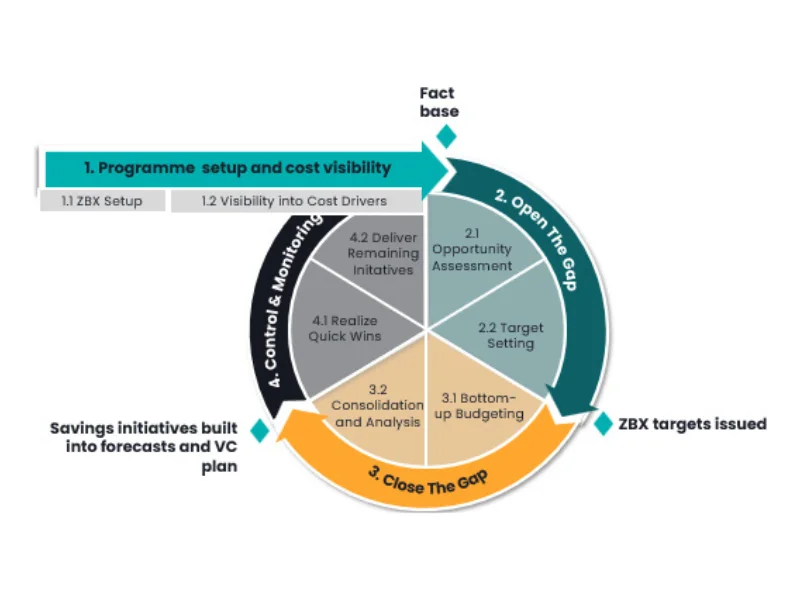
Zero-Based Everything led value creation is delivered through a multi-stage framework including following critical steps:
1 Programme Setup and Cost Visibility
- Set-up required project structure and governance.
- Visibility into cost and activities: Creating visibility is key to assess who spends how much, on what, and with whom.
- Very simply, Zero Based Everything seeks to understand cost drivers, spending rationale and link costs to business strategy. Leadership can then leverage this visibility to set intelligent targets for budget owners across the business
2 Open the Gap
- Opportunity assessment: An intelligent ‘open-the-gap’ approach requiring management to synchronise targets with an annual forward-looking planning exercise.
- Target setting: Key questions can help cost owners identify savings for each activity and define tangible targets:
- Can the activity be eliminated or stopped?
- Can the activity be reduced on a ‘minimum viable cost’ basis?
- Can the activity be performed at a lower cost?
3 Close the Gap
- Bottom-up budgeting: The ‘closing-the-gap’ mindset aims to make the fixed cost base leaner without starving the business. Creating a bottom-up budget which uses facts rather than instincts to challenge costs is critical to secure stakeholder support.
- Consolidation and Analysis: Reconcile bottom-up budgets, confirming adherence to Zero-Based Everything guidelines and policies, then assess options in terms of savings upside, costs of implementation and timelines. Data analytics and visualisation apps can improve visibility and make a significant contribution to controlling indirect spend.
- Constructive Review: Concluding the process, budget holders provide us with insights from the bottom-up analysis to revise budgets, in line with agreed savings levels. In our experience, budget submissions can remain inflated at this point, but tightening budgets rarely result in evidence of customer impact or lower top-line revenues
4 Control & Monitoring
- Realise quick wins to build momentum and fund more transformative initiatives.
- ERP-based tracking of monthly variances between the budget and the actuals with corresponding action plans are critical for the organisation to keep agile.
GET IN TOUCH WITH OUR TEAM TODAY
If you’d like to open more discussion or have your tech questions answered – please feel free to get in touch with our Partners – Darren Blackburn, Allison Ford-Langstaff and our Head of Digital Innovation – Joe Gibson. We’re always happy to collaborate, share knowledge and support.